

Why Do Some Slow Juicers Have a 15-Minute Time Limit?

Some premium juicers can run nonstop

When comparing slow juicers, most people look at features such as juice yield, RPM, or motor wattage. But one specification is often overlooked until after the juicer arrives:

How long can it run continuously?

Many slow juicers recommend operating for no more than 15–30 minutes before allowing the motor to cool. Others are designed for continuous operation without a specified cooling period. Why the difference?

The answer lies not in the wattage, but in the engineering.

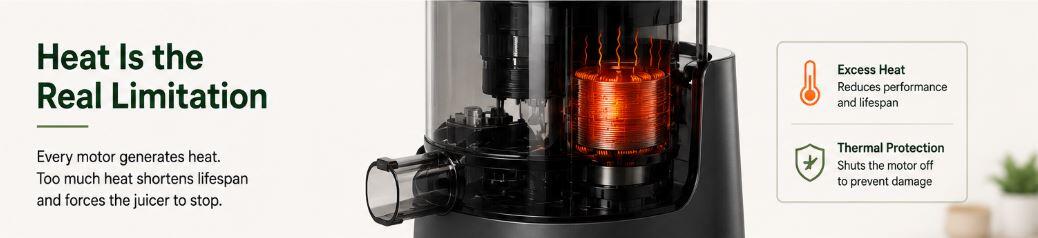
heat is the limitation

Every electric motor generates heat.

For most households, this isn't an issue. Preparing a glass or two of juice each morning places very little demand on the motor. But when processing larger quantities of produce—perhaps after harvesting apples from the garden or batch juicing for the week—heat gradually builds up inside the machine.

To protect the motor and extend its lifespan, many manufacturers recommend limiting continuous operation to around 15–30 minutes.

Most juicers also include a thermal protection sensor. If the motor reaches an unsafe temperature, the sensor automatically switches the machine off until it has cooled.

There isn't a stopwatch inside the juicer. How quickly the motor heats up depends on several factors, including the type of produce being processed, how heavily the juicer is loaded, and even the temperature of the room. Juicing soft oranges places far less demand on the motor than processing kilograms of fibrous celery, ginger, or carrots.

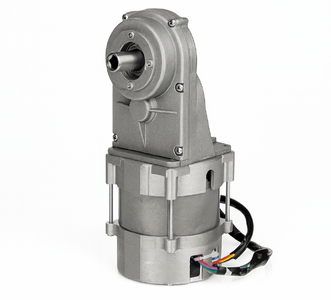
727 motor not cropped 3

Brushless DC Motors

Most household slow juicers use a traditional AC induction motor, which has proven reliable for decades.

Some premium models now use Brushless DC (BLDC) motors instead. Although significantly more expensive, they offer several advantages that make them particularly well suited to premium appliances.

Quieter Operation

BLDC motors generally operate more quietly than conventional induction motors, making early-morning juicing much more pleasant.

Higher Efficiency

Brushless motors convert electrical energy more efficiently and generate less waste heat, contributing to cooler operation during extended use.

Variable Speed

Perhaps the biggest advantage of BLDC technology is that it allows manufacturers to offer variable speed control.

Different ingredients benefit from different speeds. Leafy greens may extract more efficiently at lower speeds, while juicy fruits, homogenizing accessories, or oil extractors can benefit from higher speeds.  This level of electronic control simply isn't possible with a conventional fixed-speed induction motor.

the motor is one part

A common misconception is that a BLDC motor automatically means unlimited run time.  In reality, the motor is only one part of the system.

The gearbox, bearings, electronics, cooling system, auger design, and motor control software all contribute to how long a juicer can safely operate.  As a result, two juicers with the same type of motor may still have very different recommended operating times.

Motor technology matters—but overall engineering matters even more.

looking beyond wattage

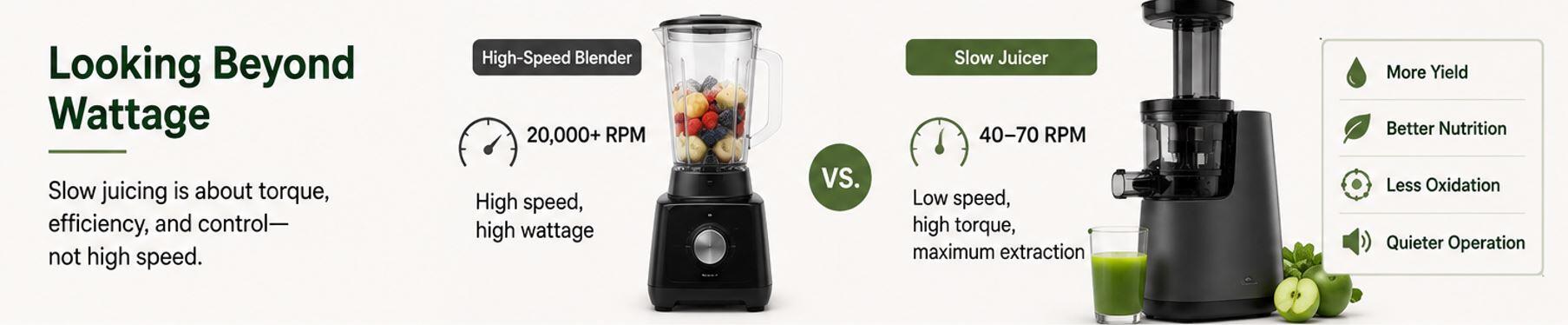
Many consumers assume that a higher wattage means a more powerful juicer.  For high-speed blenders, that's often true. They operate at tens of thousands of revolutions per minute and require substantial power to maintain those speeds.

Slow juicers are different.  Most rotate at only 40–70 RPM. The goal isn't speed, but steady, controlled crushing and squeezing.

For that reason, wattage alone tells us surprisingly little about how a slow juicer will perform. The type of motor, gearbox, juicing mechanism, electronic controls, and overall design all have a greater influence on real-world performance.

Is Continuous Operation Important?

For many people, probably not.  If you prepare a single glass of juice each morning, you'll rarely approach the operating limits of a quality slow juicer.  But if you regularly juice for a family, batch juice for the week, process produce from your garden, or use accessories such as an oil extractor, continuous operation can become a meaningful advantage.

As of this writing, Sana's premium BLDC-powered slow juicers are among the few household models designed for continuous operation without a specified cooling period. However, regardless of the motor technology used, it's always important to follow the manufacturer's operating instructions.


Key Takeaways

  • Most slow juicers recommend 15–30 minutes of continuous operation to prevent overheating.
  • Thermal protection sensors automatically switch the motor off if it becomes too hot.
  • Actual operating time depends on the produce being processed, workload, and ambient temperature.
  • BLDC motors offer quieter operation, higher efficiency, and enable variable speed control.
  • A juicer's recommended run time depends on the complete design—not just the motor.
Published: 4. August 2026